Short answer
A free IPTV trial is usually a separate test line on a separate server, handed out for two to twenty-four hours. It proves the seller has channels. It does not prove the thing you are actually buying: whether the paid line holds together at 8 p.m. on a Saturday, three weeks in, when the servers are full. That is why a trial can look perfect and the subscription can fall apart a fortnight later. The honest test is a real account on the real line with a money-back window behind it, so you can watch a full weekend of live sport and still walk away. Ours is seven days, published on the pricing page, and no card details go anywhere before you have seen the plans.
Search “IPTV free trial” and you get thousands of pages promising 24 hours for nothing. Some of them are genuine. Most are a lead magnet, and a handful are a way to collect your details. The problem is not that trials are all scams. The problem is that a trial is the easiest part of the service to make look good, so it tells you the least about the part that matters. This guide covers what a test line actually is, how to squeeze real information out of one, the red flags that mean walk away, and why a refund window beats a free day almost every time.
What an IPTV Free Trial Actually Is
When a provider gives you a trial, they are not lending you the subscription. They generate a temporary line, usually with its own username, password and expiry, and very often on a different server from the paid customers. That server is quiet. It has a handful of testers on it, not thousands of subscribers watching the same match at once.
Trial lengths cluster around a few shapes. Two hours is common on automated systems, enough to load the app and click through a few channels. Twenty-four hours is the classic offer. A few sellers run 48 or 72 hours, usually because they want you to see a weekend. Almost none of them let you keep recordings, use several devices at once, or open the full channel list, because the trial is built as a demo rather than a service.
None of that makes a trial dishonest. It makes it unrepresentative. You are test-driving a car in an empty car park and buying it for rush hour.
What a Trial Proves, and What It Hides
Split the question in two. Some things a free trial answers well, and you should use it for exactly those. Everything else it leaves open.
| Question | Does the trial answer it? |
|---|---|
| Do they carry the specific channels I care about? | Yes, and this is the best reason to take one |
| Does the line work on my box and my player? | Yes |
| Is the picture really HD, or upscaled and soft? | Yes |
| Is the EPG filled in, or a wall of blank slots? | Yes |
| Does it hold up at peak on a full server? | No, the trial server is usually near-empty |
| Will the big match stay up when everyone piles on? | No |
| Does support reply on day nineteen, not just day one? | No |
| Will the service still exist in three months? | No |
Look at where the “no” answers sit. They are all the ones that decide whether you are still happy in a month. A trial is a channel-list check and a compatibility check. Used for those two jobs it is genuinely useful. Used as proof of quality, it has tested the one hour of the week that was never going to be a problem.
How to Run a Trial So It Means Something
If you are taking a trial, spend it deliberately. Most people burn theirs flicking through channels for ten minutes at lunchtime, which is the least informative test available. Do this instead.
- Save it for prime time. Ask for the trial to start in the evening, ideally during a live match. A line that is clean at 11 a.m. tells you nothing. A line that is clean at 8 p.m. on a Saturday tells you something.
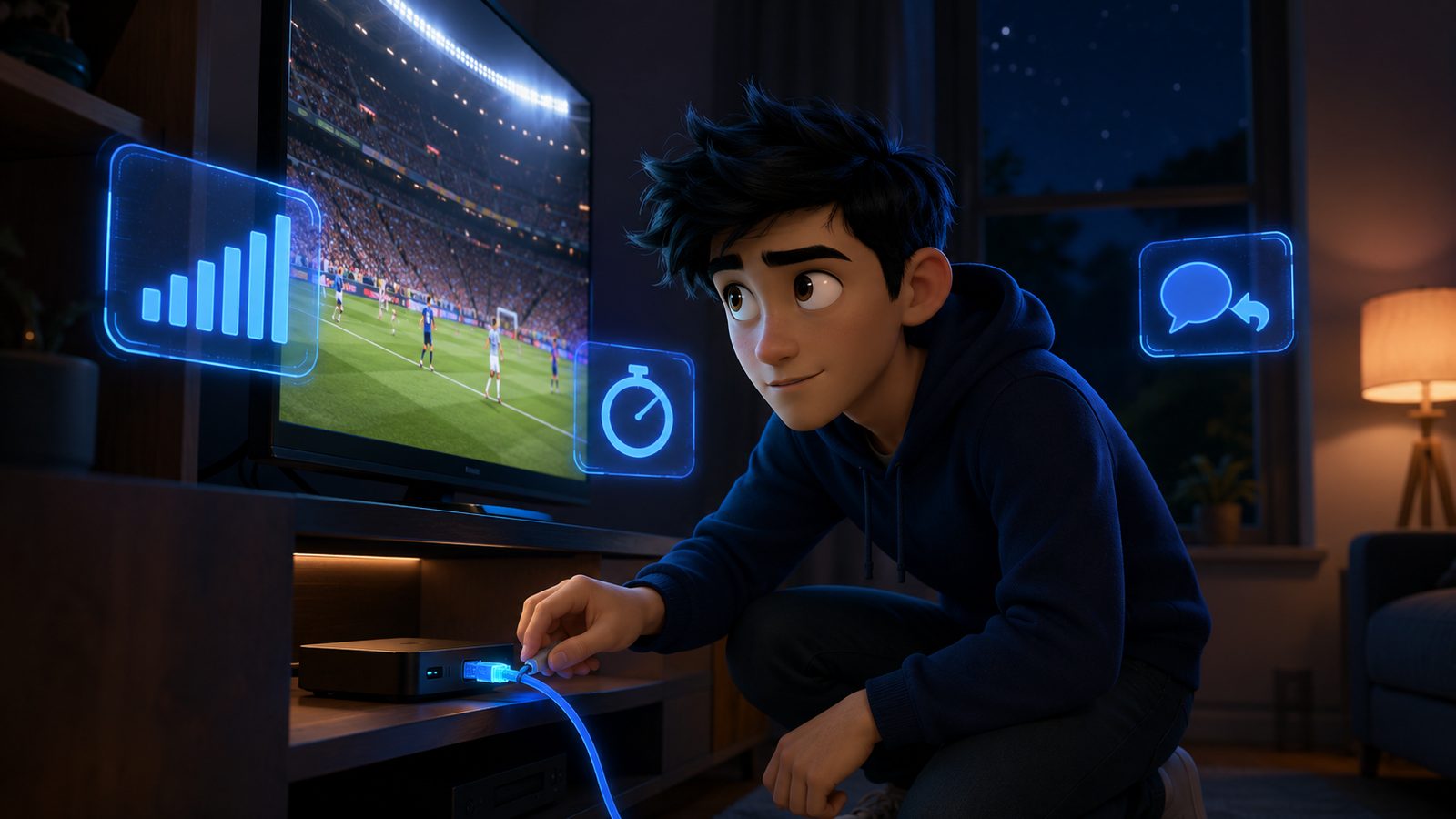
- Test it on the device you will really use, wired. Not your phone on Wi-Fi in the kitchen. Put it on the TV box on Ethernet, because a wireless test that stutters leaves you unable to tell whether the fault was theirs or yours. Our buffering guide covers why that one cable changes the result.
- Open your five channels, not their showcase. Everyone’s demo list looks fine. Go straight to the specific sports, foreign-language or regional channels you are paying for. If two of your five are missing or dead, the other 20,000 do not matter.
- Watch one thing for forty-five minutes. Channel surfing hides the failure mode. Long, uninterrupted viewing is where drops, audio drift and the freeze-at-half-time problem show up.
- Check the EPG and the catch-up. A guide with the right programme names and times means someone maintains the service. Blank slots and “No Information” mean nobody does.
- Message support during the trial and time the reply. Ask something specific, like whether a channel is available in 1080p. The speed and quality of that answer is the closest a trial gets to predicting your life as a paying customer.
- Pull the plug on purpose. Unplug the box mid-stream, plug it back in and see how fast it recovers. Reconnection behaviour is where cheap panels fall over, and you will hit it for real every time your router blinks.
Seven checks, about an hour of attention. That is the difference between a trial that answers questions and a trial that only confirms the seller owns a channel list.
When “Free Trial” Is the Warning Sign

Most trials are what they look like. A few are a funnel, and the signals are consistent enough to list.
- Card details required for a free trial. A trial line costs the seller nothing to generate. Asking for a card before you have watched a single minute is about capturing a payment method, not verifying you.
- Contact only through private chat, with no website. No prices, no terms, no refund policy, no company. When it goes wrong, there is no page to hold anyone to.
- Trial handed over instantly but prices “in DM”. Published pricing is a commitment. Pricing that only exists in a private chat changes to fit what the seller thinks you will pay.
- A twelve-month plan for the price of a coffee. Look at the annual number, not the monthly one. A service charging under a dollar a month is not funding backup feeds and spare capacity for the derby. Something has to give, and it gives at peak.
- Pressure to buy before the trial expires. “Offer ends when the trial does” is a sales tactic borrowed from timeshares. A service confident in its line does not need a countdown.
- No refund policy anywhere. This is the big one. A free trial with no money-back window behind it means every risk after the first day is yours alone.
The rule that saves people the most money: never pay a year up front on the strength of a 24-hour trial. Buy the shortest plan first, live with it through a full month including two busy weekends, and only then commit to twelve. The discount on the annual plan is worth far less than the freedom to walk away.
Why We Don’t Offer a Free Trial
We get asked for one most days, and the answer is no, so here is the reasoning rather than a policy line.
A free trial creates a second-class line by design. To hand out thousands of them without degrading the service, providers put testers on separate, quieter servers, which means the thing you tested is not the thing you bought. We would rather not run a shop window that shows different stock from the shelves. Trials also pull in volume that has nothing to do with buying: automated sign-ups, resellers sampling for their own panels, and people cycling a fresh 24 hours every night forever. That load lands on real customers’ servers at exactly the hours they care about.
So the same money goes to the other end. Everyone gets the same line as everyone else, and you get seven days to change your mind with your money back. It costs us more than a trial does, because a refund gives back real revenue while a trial gives away a spare slot. It also puts the risk in the right place: on us, for a week, on the service you actually bought.
Free Trial vs Money-Back Window
Side by side, the two offers answer very different questions.
| 24-hour free trial | 7-day money-back | |
|---|---|---|
| Which line you get | Usually a separate trial server | The same line every paying customer is on |
| Peak-hour proof | One evening at best, on a quiet server | Two weekends of real match-day load |
| Support test | Day one, while you are still a prospect | Day one and day six, as a customer |
| Stability over time | Not tested at all | A full week of it |
| Money at risk | None, until you buy blind afterwards | Your payment, refundable inside the window |
| What it costs the provider | Almost nothing | Real revenue, every time it is used |
The trial protects your money for a day and tells you very little. The refund window puts money at risk for a week and answers nearly everything. If a provider offers both, take both. If they offer only a trial with nothing behind it, you are being asked to judge a subscription by its quietest hour.
Read the refund terms before you buy, not after. A guarantee is only as good as its conditions. Check how long the window is, whether it needs a reason, and whether it survives you having actually watched something. Ours is seven days from purchase, no interrogation, and it sits on the pricing page in public where you can hold us to it.
So, Should You Take One?

Yes, if it is free, quick and you use it as a channel-list check. Take the line, run the seven checks above, and find out in an hour whether your channels exist and whether your box plays them. That is real information and it costs you nothing.
Then set aside everything else the trial seemed to say, and ask the question that predicts the next twelve months: what happens if it goes wrong after day two? If the answer is a published refund window, you can test the real service on real match-day traffic with your money still recoverable. If the answer is a shrug in an anonymous chat, the trial was never the offer. It was the bait.
ottocean runs one line for everyone, publishes its plans and prices instead of quoting them in DMs, supports Xtream Codes and M3U on any player, and backs the lot with a 7-day money-back guarantee. Set it up wired, watch one busy Saturday from kick-off to full time, and hold it to that.
Other Providers Offering Test Lines
If you want to run the test described above on more than one service, these are three more provider pages to try it against.
- KiloTV — publishes its plans openly, which makes the trial-versus-refund comparison easy.
- IPPlayTV — another line to put through the same forty-five-minute evening test.
- Tivo8K — worth trialling specifically on its 4K channels rather than its SD ones.
Frequently Asked Questions
Does ottocean offer a free trial?
No. Trials run on separate, quieter servers, so they show you a version of the service you are not actually buying. Instead every customer gets the same line, and a 7-day money-back guarantee covers the first week. That way you are testing the real thing at real peak hours, with your money refundable if it does not hold up.
Is an IPTV free trial safe to use?
Usually, with two conditions: never hand over card details for something advertised as free, and be wary of a seller with no website, no published prices and no refund policy. A trial line by itself is harmless. What some sellers collect around it is the part to watch.
Why do IPTV trials look perfect and then the paid service buffers?
Because the trial ran on a near-empty server and the subscription runs on a full one. Live streaming falls over under load, and load only arrives at peak. A quiet Tuesday afternoon on a test line predicts almost nothing about a Saturday evening on the paid line.
How long should an IPTV trial be to be useful?
Long enough to include one evening of live sport. Two hours in the daytime is a compatibility check and nothing more. Twenty-four hours works if you deliberately spend it at prime time rather than at lunch.
Can I get an IPTV trial without giving card details?
Yes, and you should insist on it. Generating a test line costs a provider nothing, so a card requirement on a free trial is about storing a payment method rather than about the trial. Walk away and find one of the many sellers who ask for nothing but an email.
Is a money-back guarantee better than a free trial?
For judging quality, yes. A refund window puts you on the same line as every other customer for a full week, including two busy weekends, and it costs the provider real money when you use it. A trial costs them a spare slot on a quiet server. One of those is a commitment, the other is a demo.
What should I test during an IPTV trial?
Your own five channels, on your own box, wired, in the evening, watching one thing for forty-five minutes rather than surfing. Check the EPG is filled in, message support with a specific question and time the reply, and unplug the box mid-stream to see how fast it reconnects.
Should I buy a yearly plan straight after a good trial?
No. A 24-hour trial cannot tell you what the service looks like in week six, and the annual discount is small next to losing twelve months to a service that folds in month two. Buy the shortest plan, live through a full month, then commit if it earned it.
Skip the trial. Test the real line for a week.
One line for every customer, public prices, Xtream Codes and M3U on any player, and a 7-day money-back guarantee so the risk sits with us while you watch a full match weekend.